
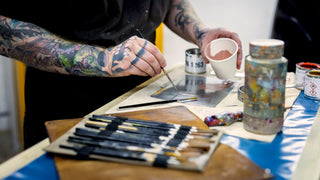
Author: Nargess Banks
At Rolls-Royce, almost anything a client can imagine is made real, by hand. We go inside the Bespoke Collective to meet its makers, and the craft beneath the surface.
Earlier this year, Rolls-Royce invited the Paris-based artist Cyril Kongo to co-create five privately commissioned Black Badge Cullinans. The artist, celebrated for bringing graffiti from the city’s walls to the gallery space in the 1980s, relocated to the House of Rolls-Royce amid the South Downs, for what amounted to an art residency.
Kongo settled in his temporary studio space tucked inside the marque’s Bespoke Collective facilities to understand what is possible, and what can be made possible. Turns out most requests were met with the enthusiasm from a company accustomed to pushing boundaries.

When Kongo proposed colour on the LED headliner, Rolls-Royce admitted they had never done it, but would try. For the ‘Starlight Headliner’ Kongo wanted 1,344 stars placed strategically by hand so no two car experiences would be alike. The team made this happen. Phil Fabre de la Grange, head of Rolls-Royce Bespoke Collective, describes the experience as “a continuous exchange of ideas and a shared spirit of curiosity and creative confidence.”

These skills were pushed even further at the latest London Craft Week, when Rolls-Royce built two artworks for the ‘Phantom Gallery’ on the dashboard using centuries-old techniques. One is a Dutch still life rendered in three dimensions, featuring 50 hydrangea blooms sculpted from leather and painted petal by petal, pomegranate seeds formed from 76 hand-sewn beads. The other grows a flat draughtsman’s drawing into a jewel, a flower of five brass petals, waterjet-cut, each one hand-engraved with 50 lines just 0.2mm wide.

These are only the latest signs of the Rolls-Royce promise: that almost anything a client can dream, the marque will find a way to make happen. Through its Bespoke Collective of designers, engineers and artisans, the marque will intentionally push the discipline to somewhere quite extraordinary.
Having spent time at the workshops, watching these men and women at work – a leaf built entirely from thread, a single star set by hand, wood steamed gently, gently to mould into place – the skills required, the attention needed, and the sheer love and joy of making is admirable.

We sat down with the Bespoke Collective to hear how it is all done.
With Rolls-Royce clients increasingly asking for an individual touch to their cars, what are typical requests?
From their initials applied to the headrests to million-stitch embroideries. Embroidery depicting the surface of the moon. Bespoke embossed graphics. Hand-painted artworks using leather as a canvas. Even three-dimensional embroidery. The possibilities are limited only by the client’s imagination.
So much of a Rolls-Royce interior is made of natural materials, with wood such an essential component. How is the material chosen?
The visible wood elements are made using veneers: thin sheets of wood that are bonded to a substructure. All veneer parts used in any single motor car will come from the same tree, with colours, patterns and grains that give the motor car its own unique ‘fingerprint’ which cannot be precisely replicated again. This also ensures all wood parts age consistently, an important consideration, as many Rolls-Royce motor cars are lovingly handed down through the generations.

What happens to the veneers when they first arrive here?
Our clients will select from around 30 different interior surfaces, with different stains, overlays. On arrival, all veneers are transferred to the richly scented humidor, where they are stored for a minimum of three days at a constant climate, to prevent the wood from cracking and to keep it flexible enough to take our complex forms.
How do you get the grain to run as a single, perfect line through the car?
Almost every veneer part begins life in the Veneer Preparation area, where specialists align the grains and patterns to create a single, perfect line running through the motor car. Straight-grained woods like Royal Walnut are matched in different ways depending on model variant.

For example, the Cullinan can host either a horizontal grain flow across the components or as a chevron pattern hosting a centreline book-match flowing throughout the vehicle at a 55˚ angle. Complex figured woods such as Burr Walnut are laid so they form a book-matched mirror image, we do this by aligning the layers in sequential order and sand by hand the 0.5mm edges of the centreline join creating perfect symmetry between the left and right side. The matched veneer edges are then bonded together ready for the individual geometries to be cut using precision lasers.
How is each veneered part then built up and made to last?
Each part is made up of several layers of wood veneer, interleaved with glue sheets, and bonded under heat and pressure against a sub-structure composite within a hydraulic press machine with specific tool inserts related to model content. All the interior architecture is tested in a variety of ways to ensure they will remain stable once installed in the finished motor car. Lastly, all parts are manually sanded using an orbital sander. Knowing how much of the wood surface to remove is a matter of experience and requires a good eye and a steady hand.
A Rolls-Royce has to be flawless. How much of that final perfection still comes down to the human eye?
Absolutely. Before progressing to the lacquering stage, every component receives a detailed inspection. A highly experienced craftsperson applies an engineered wash-over solution that temporarily imitates the final lacquered finish, enabling them to highlight and qualify every detail on the surface. Everything here is examined by eye. The only technology used within the process is to control and record data.

And the lacquer, how do you build that deep, mirror shine that we associate with Rolls-Royce?
Multiple layers of lacquer are applied to the veneered parts in the final process. Each layer is hand sprayed approximately every 20 minutes, although this will vary depending on temperature, atmospheric pressure and other factors. With all the layers applied, the part will show a slight ‘orange peel’ effect on the surface. To eliminate this, the part is sanded back and then polished to a deep, mirror shine.
Open-pore finishes – where the grain and texture are exposed to create a tactile sensation – are finished with a specially developed matte sealant. After completion, all connecting features are also sub-assembled within the Interior Surface Centre giving full respect to the delicacy of the component that is then hand delivered to the car on the assembly line.
Leather is also a main component of a Rolls-Royce cabin. How is it prepared, softened and shaped to fit each panel?
Each hide that arrives is meticulously inspected by hand and eye under high-intensity lighting to reveal even the smallest imperfections, such as stretch marks or insect bites. Areas deemed unsuitable for use are carefully marked with chalk before the hide is placed into our cutting process which uses a special algorithm developed to analyse the chalked areas and generate a pattern that excludes the marked areas.

The machine outlines each part required to create the interior with a laser projected onto the hide before it’s cut. Artisans then manually adjust and further perfect the cutting pattern to maximise the use of leather. Selected leather patterns are split or ‘skived’ to reduce thickness for comfort and for precision stitching and seamlines.
That’s a labour intensive process. How are the leather elements made to be so precise?
Using high-precision sewing machines, the leather parts are sewn by hand by our skilled craftspeople and, depending on the client’s request, are completed with contrast stitching or piping. Finally, the leather parts are fitted to a component – a task which can only be completed by hand, due to complex geometries including curves and contours of these parts.

Customers are also asking for other fabrics, wool and cashmere. How have you responded to new material palettes?
Over the past decade, we have been exploring textiles. The idea is inspired by our heritage, recalling the early years of Rolls-Royce, where passenger seats were upholstered with various precious textiles. More recently, we introduced Duality Twill, the first fabric available beyond Bespoke commissions. Duality Twill interior can incorporate up to 2.2 million stitches requiring 11 miles of thread. It’s the product of 20 hours of construction.
What is the most demanding part of the interior to do by hand?
There are so many complex elements. Perhaps one of the most technically challenging is creating the ‘Starlight Headliner’, a spellbinding Bespoke feature, iconic and exclusive to Rolls-Royce. The ‘stars’ are optical fibres, each inserted by hand into an individually hand-placed perforation. Between 800 and 1,600 are fitted, depending on the design and model. Fibre optic strands are delicately placed at varying depths and at different angles, which allows light to escape in multiple directions and at different intensities, faithfully replicating the night sky.
Photography, Rolls-Royce Bespoke Collective at work, Cyril Kongo privately commissioned Black Badge Cullinans. Copyright ©Rolls-Royce Motor Cars